


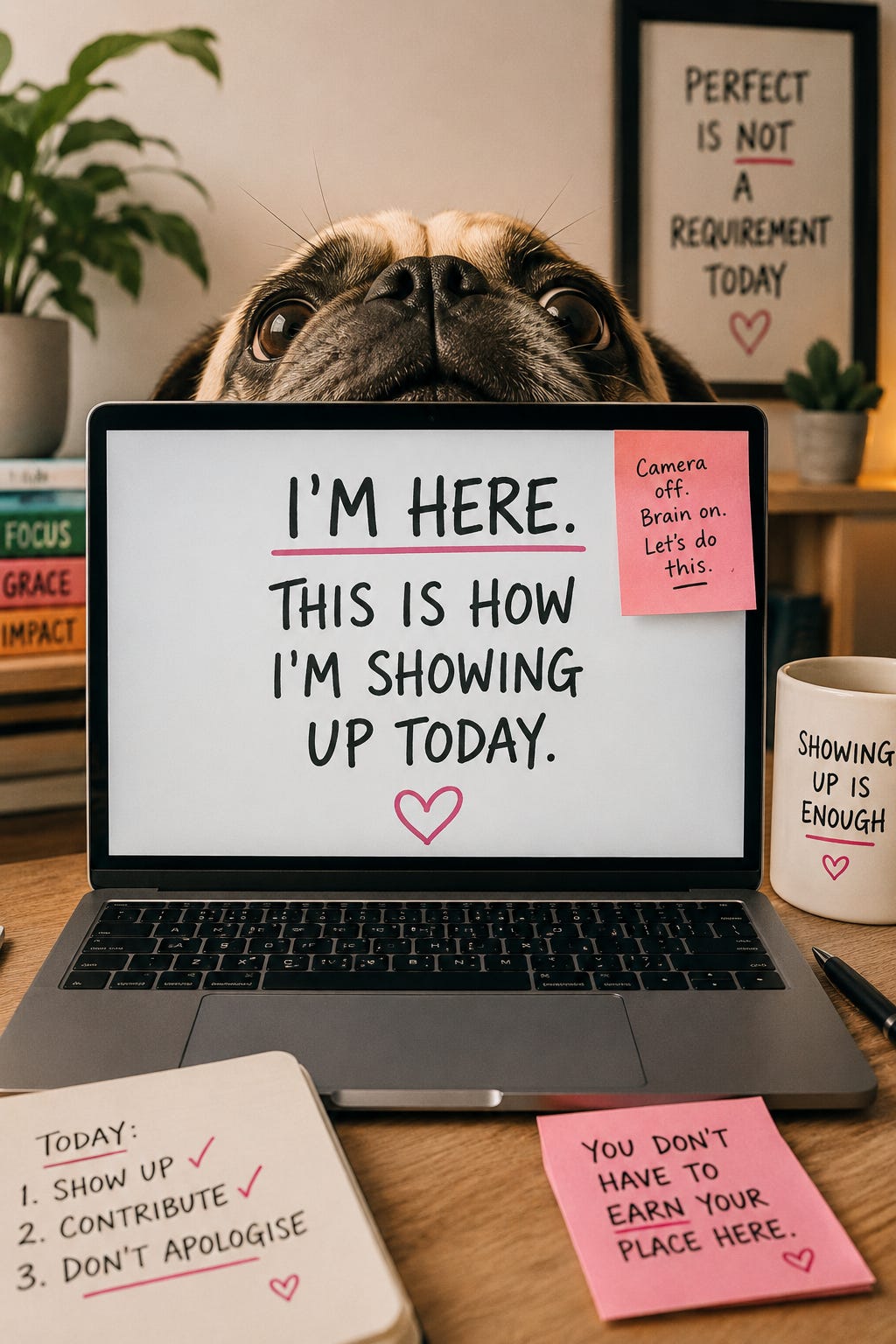
A friend and colleague asked me recently whether it would be alright if she joined a meeting with her camera turned off.
She wasn’t feeling particularly well. She still wanted to attend. She still wanted to contribute. She just didn’t want to be on camera.
Of course, I didn’t mind.
But afterwards I found myself wondering why she felt she had to ask.
Why do we feel we need permission for things like this?
Why do we feel we need to explain ourselves before making small adjustments that help us get through the day?
The thing is, she was still showing up.
She was still attending the meeting.
She was still contributing.
She was still doing what needed to be done.
The camera being on or off didn’t change any of that.
And yet she felt she needed permission.
It made me realise how often we apologise for being human.
Sorry I’m tired.
Sorry I’m not feeling well.
Sorry my camera is off.
Sorry I don’t have much energy today.
Sorry I don’t look my best.
Sorry I’m not as cheerful as usual.
Somewhere along the line we’ve learned that showing up isn’t enough. We feel we have to perform showing up.
Now don’t get me wrong. There are situations where presentation matters. If you’re meeting a client for the first time, giving a keynote speech, attending a job interview, or representing your business publicly, then how you present yourself is part of the job.
But most meetings aren’t that.
Most meetings are simply people trying to get things done.
Now, I appreciate not everybody experiences video calls in the same way.
Some people barely notice their own image on screen. They switch the camera on, get on with the meeting, and think nothing of it.
But for others, the experience is very different.
One of the strangest things about modern working life is that we’ve somehow accepted that it’s normal to spend part of the day with our own face staring back at us.
I don’t know about you, but I don’t particularly enjoy spending hours looking up my own nostrils.
In a face-to-face meeting, I don’t carry a mirror around and stare at myself while I’m talking. I pay attention to the conversation.
On video calls, though, there can be an extra layer of self-awareness. We might notice our hair, our expression, the lighting, whether we look tired, or whether we appear engaged enough.
Not everyone finds that distracting, but some of us do.
And sometimes turning the camera off isn’t about hiding.
It’s simply about removing one more thing that’s competing for our attention.
The more I thought about it, the more I realised this wasn’t really about video calls at all.
It was about permission.
Or perhaps the fact that we often don’t need it.
Maybe it’s enough to say:
“I’m here.”
“This is how I’m showing up today.”
No long explanation.
No apology.
No justification.
Just an honest acknowledgement of where you are.
Because showing up is not the same thing as performing.
Some days I show up full of energy, ideas and enthusiasm.
Other days I show up tired, distracted, overwhelmed, under the weather, or simply not in the mood to spend an hour looking at myself on a screen.
Both versions of me are still me.
Both versions can contribute.
Both versions deserve a seat at the table.
Perhaps we would all be a little kinder to ourselves if we stopped demanding perfection before allowing ourselves to participate. Perhaps we could simply trust that being present has value. And perhaps, every now and then, we could allow ourselves to say:
“I’m here. This is how I’m showing up today.”
And let that be enough.